How to Get Your Brand Cited by ChatGPT and AI Search
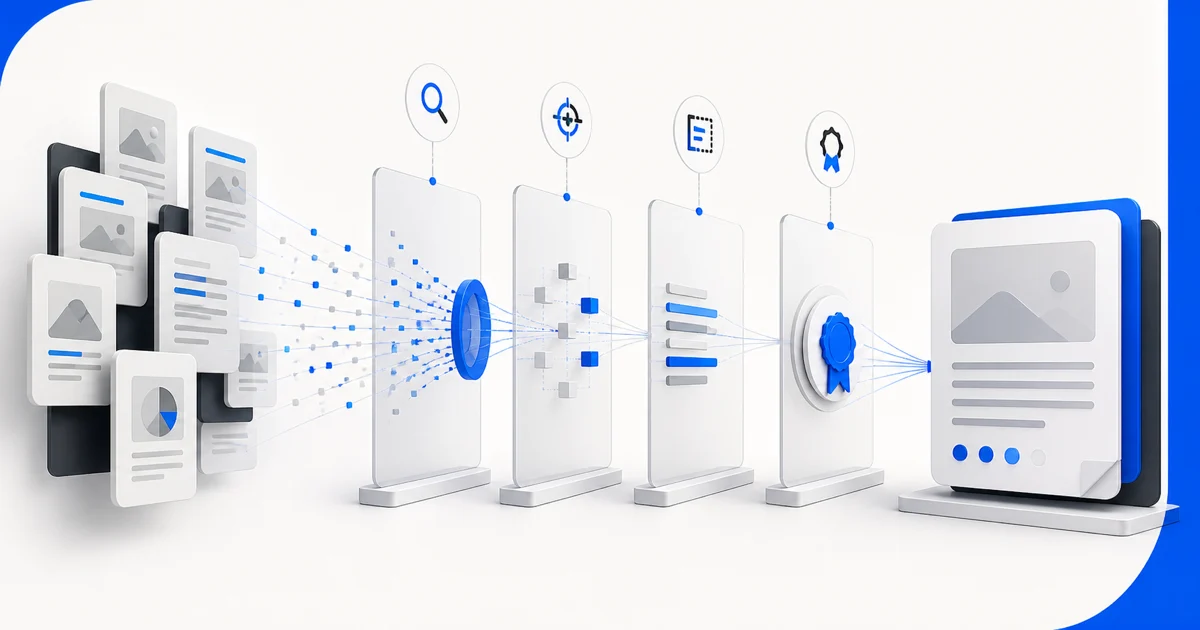
To get cited by ChatGPT and other AI search engines, your content must first be retrievable — crawlable, fast and ranking for the underlying query — then structured so a specific passage can be extracted cleanly, then corroborated by enough independent sources that the model treats you as a safe attribution. Those three stages happen in order, and failing any one of them means you are never considered.
Why this suddenly matters
For twenty-five years, search worked one way: you typed something, you got a list, you chose. The entire discipline of SEO was built around improving your position in that list.
A meaningful share of that behaviour has moved. Someone who once searched "best project management tool for a small agency" and compared six articles now asks an assistant the same question and receives three recommendations with reasoning attached. If your brand is not among the three, you were never in the running — and here is the uncomfortable part: nothing in your analytics will tell you. Your rankings did not change. Your traffic dipped slightly and you attributed it to seasonality. You simply stopped being considered, invisibly.
That invisibility is the strategic problem. Businesses can lose the consideration stage entirely while every dashboard they look at continues to appear healthy.
How AI answer engines actually decide
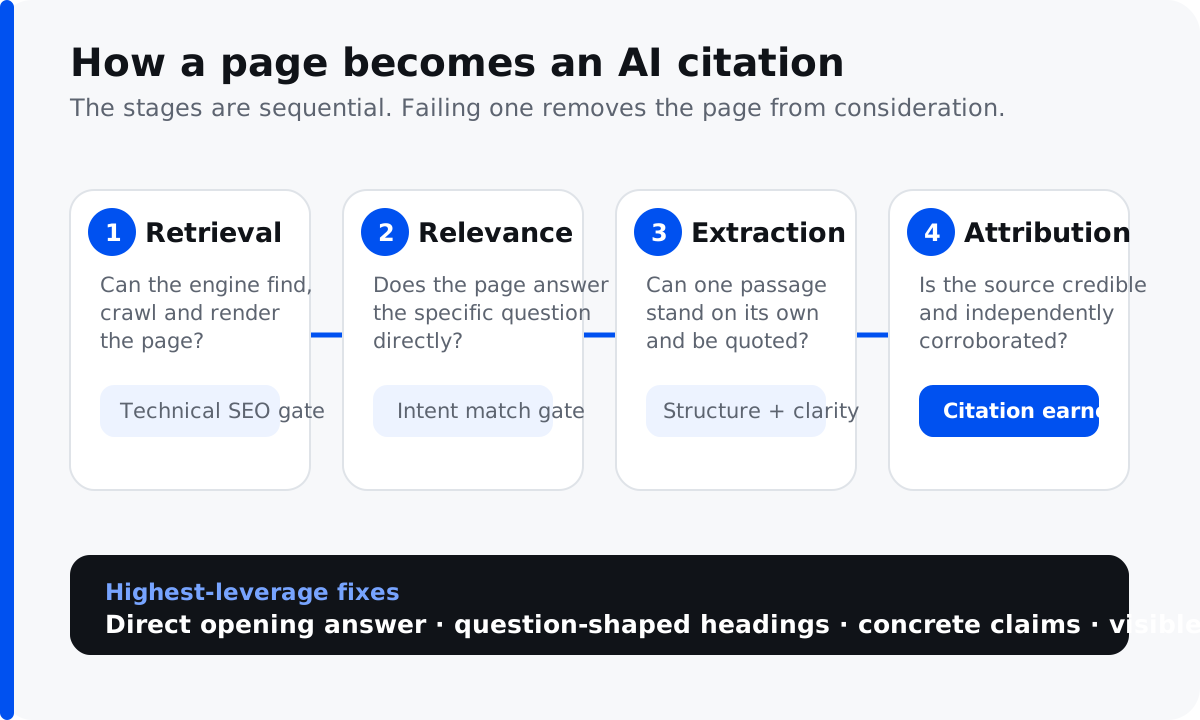
Understanding the mechanism matters, because most advice circulating about "optimising for AI" targets the wrong stage of it. There are roughly four steps.
Step one: retrieval
When an engine receives a question it cannot confidently answer from training data alone — anything current, local, commercial or specific — it performs a live search and gathers candidate sources. This is genuine web retrieval, and it means your page has to be findable by conventional means.
If your site is slow, blocked by robots directives, dependent on client-side JavaScript to render its content, or simply not ranking for the underlying query, you are eliminated here. No amount of clever content structuring rescues a page that never enters the candidate set. This is why the agencies selling "GEO" as something entirely separate from SEO are misleading people — retrieval is the gate, and retrieval is ordinary technical SEO.
Step two: relevance assessment
The engine evaluates which of the retrieved sources actually address the question. This is where content that buries its answer suffers. A page that spends four paragraphs on preamble before reaching the point is harder to assess as relevant than one that answers in the opening line.
Step three: extraction
The model pulls specific passages it can use. This is the stage most directly within your control, and it rewards a particular kind of writing: self-contained statements that make sense without surrounding context, concrete claims rather than vague ones, and clear structural signals about what each section covers.
A sentence that begins "As we discussed above, this approach can sometimes be beneficial depending on circumstances" is nearly useless for extraction. A sentence that begins "Service-area businesses should define a realistic radius rather than claiming national coverage, because an oversized service area dilutes local relevance" can be lifted directly into an answer.
Step four: attribution
Finally the engine decides which sources to name. Models are conservative here — attributing a claim to a source is a form of endorsement, and the systems are tuned to prefer sources that appear credible and corroborated. A claim appearing on one unknown site is riskier to cite than the same claim appearing across several recognised ones.
The engines differ, but less than you would expect
Four systems currently drive most AI-mediated discovery, and they behave differently enough to be worth understanding.
ChatGPT answers from training data for general questions and searches live for anything current or specific. Citations appear when it has searched. It tends toward fewer, more consolidated sources.
Google AI Overviews appear above traditional results for a subset of queries. They draw heavily on pages already ranking well, which makes conventional SEO performance a strong predictor of inclusion.
Perplexity is search-first by design and cites more liberally, often listing many sources per answer. It is generally the most accessible to smaller sites, and a reasonable place to see early results.
Gemini powers Google's broader AI surfaces and shares much of the underlying infrastructure with AI Overviews.
The encouraging part is that the underlying requirements converge. All four need to retrieve your page, all four favour extractable structure, and all four weigh corroboration. Optimising properly for one improves your position across the others.
What the research actually found
There is more than opinion available here. Academic researchers from Princeton, Georgia Tech and IIT Delhi studied generative engine optimisation systematically, testing which content modifications changed how frequently and prominently sources were cited in generated answers.
Their findings were consistent and, usefully, quite specific. Adding relevant statistics, citing sources, and including quotations from credible authorities produced the largest improvements in visibility within AI-generated answers. Adding keywords in the traditional SEO sense produced comparatively little.
That result deserves attention because it inverts a habit. Content optimised for classic search often avoids sending readers elsewhere; content optimised for citation benefits from demonstrating its own sourcing. Being visibly well-researched appears to make a page a more attractive thing to quote.
The practical playbook
1. Fix retrieval before anything else
Confirm your important pages are crawlable, render their content server-side or statically, and load quickly on a mobile connection. Check whether you rank at all for the questions you want to be cited on — if you are nowhere in conventional results, that is the first problem to solve, not a separate one.
Our technical SEO checklist covers the diagnostic work. This stage is unglamorous and it is where most failed AI visibility efforts actually fail.
2. Answer in the opening lines
Put a direct, complete answer to the page's core question in the first paragraph. Not a summary of what you will cover — the actual answer. Then expand beneath it for readers who want depth.
This feels counterintuitive to anyone trained to build toward a conclusion, and it is the single highest-leverage structural change available. It serves readers too: someone who wanted a quick answer gets it, and someone who wanted detail scrolls.
3. Phrase headings as real questions
A heading reading "How much does local SEO cost for a small business?" matches how people ask far more closely than "Pricing" or "Investment considerations". Headings are strong structural signals for extraction, and question-shaped ones map directly onto the queries you want to appear for.
Look at the questions genuinely asked by your customers — sales calls, support tickets, the "people also ask" boxes in search results — and use their phrasing rather than your industry's internal vocabulary.
4. Write self-contained passages
Each section should make sense if lifted out on its own. Avoid opening paragraphs with "This means that…" or "As mentioned earlier…", because a passage that depends on preceding context cannot be extracted cleanly.
Practically: name the subject in the sentence rather than relying on pronouns, and state conclusions explicitly rather than implying them from what came before.
5. Be specific and concrete
"Local SEO can improve visibility" is unquotable. "Map pack movement typically becomes visible within 30 to 90 days in moderately competitive markets" is quotable, because it states something definite that an answer can attribute to you.
This does not mean inventing precision. It means committing to real positions, giving actual ranges, naming the conditions under which something holds, and being willing to be specific enough to be wrong.
6. Show your sourcing
Cite where your claims come from. Link to primary documentation, name research, quote credible authorities. The academic work suggests this measurably improves citation likelihood, and it is good practice regardless — a page that shows its working is more trustworthy to human readers too.
7. Make your entity unambiguous
AI systems build a model of who you are from structured data, consistent information across the web, and how others describe you. Ambiguity hurts: inconsistent business names, an outdated description on a directory, confusion with a similarly named company.
Implement organisation schema properly, keep your details consistent everywhere they appear, and make sure your own site states plainly what you do and who you serve. Our local rankings guide covers the consistency work in detail for location-based businesses.
8. Build corroboration
The hardest and slowest part, and the most defensible once achieved. Being mentioned across multiple credible independent sources makes you a safer attribution. This is conventional authority building — digital PR, genuine industry presence, earned coverage — and it now pays off twice.
Our guide to off-page SEO covers the tactics that still work and the ones that carry risk.
A worked example
Abstract advice about structure is easy to nod along with and hard to apply, so here is the same information written two ways.
The version that will not be cited:
"When it comes to improving your visibility in local search results, there are a number of factors that businesses should take into consideration. Many companies find that their efforts in this area can be quite rewarding, though results may vary depending on a range of circumstances. In our experience working with clients across various sectors, we have found that a comprehensive approach tends to yield the best outcomes over time."
That paragraph contains no extractable claim. It states nothing definite, commits to no position, and could describe almost any marketing activity. A model looking for something to quote finds nothing to take.
The version that can be:
"Your Google Business Profile primary category is the strongest single relevance signal in local search. Changing it from a general category to the one that precisely describes your main service frequently produces movement within weeks, and it costs nothing. Businesses in moderately competitive markets typically see map pack changes within 30 to 90 days once the profile, citations and review process are working together."
Same subject, entirely different citability. It names a specific mechanism, commits to a claim, gives a timeframe with a stated condition, and each sentence survives being lifted out on its own.
The uncomfortable observation is that the first version is how a great deal of agency and B2B content is written — hedged, general, careful to avoid being wrong. That style was always weak, but conventional search tolerated it because keyword relevance carried the page. Extraction does not tolerate it at all.
Applying the test to your own pages
Take any page you want cited and read it looking for sentences that could stand alone as an answer. If you cannot find three, the page is unlikely to be quoted regardless of how well it ranks. The fix is usually not more words — it is committing to specifics you were previously hedging around.
This applies differently by content type
How-to and explanatory content benefits most directly. These are the queries AI answers handle best, and clear step-by-step structure with definite statements maps cleanly onto what gets extracted.
Comparison content is increasingly valuable, because "which is better for X" is exactly the sort of question people bring to assistants. Genuine comparison — with stated criteria and honest trade-offs — is far more citable than content that pretends to compare while promoting one option.
Product and service pages are less likely to be quoted directly but heavily influence what models believe about you. Clear, specific descriptions of what you do and who you serve feed the entity understanding that determines whether you get recommended at all.
Opinion and analysis is underrated here. Models frequently cite sources that take a clear position, because a definite view is quotable in a way that balanced summary is not. Having an argument is a competitive advantage.
Check what AI currently says about you
Before optimising anything, find out where you stand. Build a list of ten to twenty questions your buyers genuinely ask — not keywords, full questions — and run them across ChatGPT, Google AI Overviews, Perplexity and Gemini. Record what comes back.
Three things typically emerge, and all three are useful.
You are absent. Competitors get named and you do not. This is the common case and it tells you where the gap is.
You are mentioned inaccurately. Outdated pricing, services you discontinued, wrong location, confusion with another business. This is more common than people expect and it is often the highest-value fix available, because it is actively costing you rather than merely failing to help.
You are cited well. Worth understanding why, because whatever produced that outcome can usually be replicated on other topics.
Re-run the same question set periodically. Without a baseline you cannot tell whether anything you did worked.
What not to do
Do not publish large volumes of generated content hoping to increase surface area. Models are increasingly capable of recognising undifferentiated generated text, and more importantly it contains nothing worth citing — no original position, no specific data, no experience. It also carries genuine risk under search quality guidelines around scaled content abuse.
Do not attempt to manipulate models with hidden text or instructions embedded in pages. Beyond being ineffective at scale, it is exactly the behaviour these systems are being hardened against.
Do not buy "AI visibility" packages that promise citation without addressing your technical foundations or authority. If retrieval is broken, nothing downstream matters, and any provider not starting there is selling packaging.
And be sceptical of anyone claiming a proprietary method for guaranteed AI citation. Nobody controls these systems, the mechanisms shift, and confident guarantees are a reliable signal of overselling.
How long this takes
Faster than traditional SEO in some respects and slower in others. Accuracy corrections and content restructuring can change what engines say within weeks, particularly on Perplexity, which retrieves aggressively. Becoming a consistently cited source across multiple engines takes months, because it depends on corroboration that accumulates at the pace of ordinary authority building.
A reasonable expectation: visible changes on individual questions within four to eight weeks if your foundations are sound, and a meaningful shift in overall visibility across a query set over two to three quarters.
Why smaller businesses have an unusual advantage here
Large brands already have the mention volume that makes models comfortable citing them. That looks like an insurmountable disadvantage, and on broad questions it largely is.
But AI answers are frequently given to narrow, specific questions — and specificity is where a smaller business can genuinely win. A specialist who has solved one problem repeatedly can write something more useful, more concrete and more evidently expert than a large generalist competitor covering the same topic superficially. On the question "what causes X in Y situation", depth beats brand recognition more often than it does in conventional search.
The window will not stay this open. Most businesses have no AI visibility baseline at all, which means the competitive bar is currently low in a way it will not remain.
Where to start this week
Pick your five most commercially important questions. Run them through the four engines and write down what happens. Then take the page on your site that should answer each one, and do three things to it: put a direct answer in the opening paragraph, rewrite the headings as the questions people actually ask, and add one specific, concrete fact you can stand behind.
That is a few hours of work and it addresses the stages you control most directly. Re-check in a month.
If you would rather have the whole programme handled — benchmarking, accuracy correction, restructuring and the corroboration work — our AI SEO services cover it end to end, and it sits on the foundations built by our wider SEO services.
Google's own guidance on AI features in Search is worth reading directly — notably, their position is that succeeding in AI experiences is fundamentally the same work as succeeding in Search.