Voice Search SEO: What Actually Matters Now

Voice search SEO means optimising for spoken queries — which are longer, more conversational and more often local or immediate than typed searches. The practical work is answering specific questions directly and concisely, keeping your business information accurate, and making pages fast. Much of it now overlaps with optimising for AI assistants, which is where the real opportunity sits.
An honest assessment first
Voice search was the subject of a great deal of overstatement. For years the industry repeated predictions that half of all searches would be voice by a given date, and businesses were sold "voice optimisation" packages on that basis. Those predictions did not hold up in the way they were presented, and a lot of that spending achieved very little.
So it is worth being clear about what genuinely matters. Voice is not a separate search engine you optimise for independently. It is a different way of asking, which surfaces existing results differently. The underlying rankings are largely the same — what changes is how queries are phrased and how answers are delivered.
What makes it worth attention now is not voice itself. It is that the behaviour voice introduced — asking full questions conversationally, expecting one answer rather than a list — is exactly how people interact with AI assistants. The optimisation work transfers almost entirely.
How spoken queries differ
Three consistent differences shape everything else.
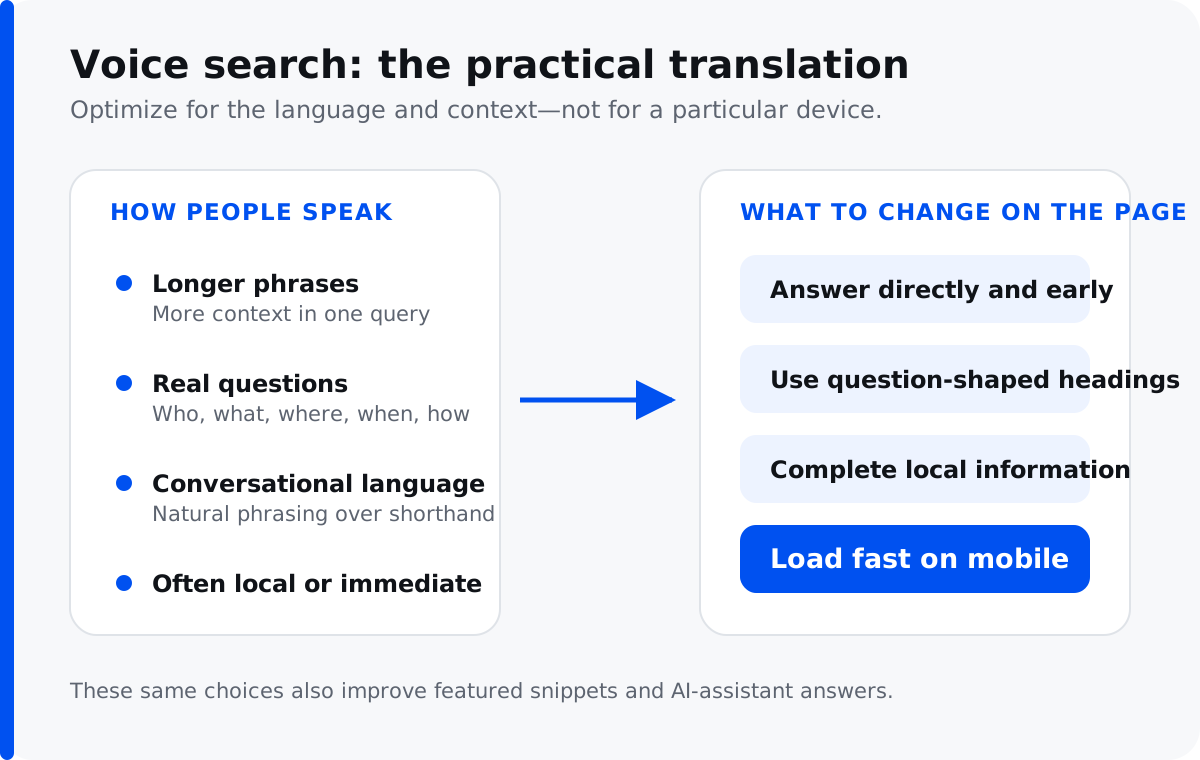
They are longer. Someone types "italian restaurant manchester" and says "what's a good Italian restaurant near me that's open now". More words, more specificity, more natural phrasing.
They are questions. Spoken queries begin with who, what, where, when, why and how far more often than typed ones, because speaking to a device feels like asking rather than searching.
They carry more immediacy. Voice is used hands-free — driving, cooking, walking — which correlates with wanting something now rather than researching for later. "Near me" and "open now" are disproportionately spoken.
What to actually do about it
Answer questions directly and early
The single most useful change. When a page answers a question, put the answer immediately after the heading in a concise, self-contained sentence or two, then expand underneath. Voice assistants and AI systems both extract short passages, and one that requires assembling from three paragraphs will not be selected.
This is a genuinely useful discipline regardless — readers benefit from a direct answer before the detail.
Use headings phrased as real questions
A heading reading "How much does a boiler service cost?" matches spoken queries far more closely than "Pricing". Write headings the way customers ask, not the way your industry categorises.
Your FAQ content is unusually valuable here, because the format already matches the query shape. Genuine questions with genuine answers, rather than marketing statements dressed as questions.
Get your local information right
A large share of voice searches are local, and assistants pull business details from structured sources. Accurate opening hours, address and phone number matter more than usual — if your hours are wrong, a voice assistant will confidently tell someone you are open when you are closed.
Our guide to improving local rankings covers the profile and citation work this depends on.
Be fast
Voice results tend to come from pages that load quickly, and the context is usually mobile on a variable connection. This is the same work as mobile SEO rather than a separate task.
Where this now leads: AI assistants
The reason to care about any of this in 2026 is that conversational querying became the norm through a different route than expected. People now ask ChatGPT, Gemini and similar assistants full questions and receive a single synthesised answer, frequently citing a handful of sources.
The optimisation requirements are nearly identical to voice: direct answers, question-shaped headings, clear structure, concrete facts and demonstrable credibility. The difference is that the stakes are higher, because an AI answer often replaces the results page entirely rather than reading one result aloud.
So the practical advice is to do this work, but to frame it correctly. You are not optimising for smart speakers. You are structuring content so machines can extract a trustworthy answer from it — which serves voice, AI assistants and featured snippets simultaneously. That is what our AI SEO service addresses directly.
What not to bother with
Do not write pages targeting "voice search keywords" as a separate content strategy. There is no meaningfully separate keyword set — there are conversational versions of queries you should already be covering.
Do not add awkward spoken-sounding phrases to your copy in the hope of matching speech patterns. It reads badly to humans and does not help.
And be sceptical of anyone selling voice optimisation as a distinct service with its own fee. It is a subset of doing content and local SEO properly, and any agency positioning it otherwise is selling packaging.
Long-tail and conversational keywords
The keyword work behind voice search optimization is really long-tail keyword work. A typed query might be two words; the spoken version is a full sentence. Rather than chasing a separate set of voice search keywords, map the conversational keywords your customers actually speak — the "how do I", "where can I", "what's the best" phrasings — onto pages you already have. Voice search queries are long, specific and low in ambiguity, which means they convert well when you rank for them.
A useful exercise: say your target queries out loud. If the phrasing you have optimised for is not how a person would ask a voice assistant, you have found a gap. Focus on conversational keywords and natural questions rather than the compressed keyword strings people type.
Schema markup helps search engines understand your content
Structured data is one of the few things that genuinely counts as voice search SEO in its own right. Schema markup helps search engines understand the context of a page — what is a product, a price, an opening time, a question and its answer — and that understanding is what lets an assistant read a confident answer aloud. FAQ schema is especially useful because it maps directly onto the question-and-answer shape of spoken queries, and LocalBusiness schema keeps your details machine-readable.
Search engines use this markup to select passages for voice search results and featured snippets alike, so the same work that helps voice improves your visibility in ordinary search results too. This sits within our technical SEO work.
Voice assistants and where they get their answers
It helps to know that voice assistants like Siri, Alexa and Google Assistant do not share one index. Google Assistant leans on Google, Alexa historically leaned on Bing, and each surfaces results in its own way. What they have in common is that they read a single answer rather than a list, which raises the stakes: appearing in voice search results usually means being the one source selected, not one of ten.
Many voice searches are local — someone using voice commands to find a business nearby while driving or walking. That makes your local SEO the foundation of local voice search visibility, because assistants pull business details from the same structured sources. Improve your local SEO and you improve your chances of ranking for voice at the same time.
How to measure voice search performance
Be realistic here: you cannot cleanly isolate voice search in your analytics. Search engines do not hand you a "voice" segment, so anyone promising precise voice search reporting is overstating what is possible. What you can track are the proxies that move when voice and AI visibility improve — featured snippet and "position zero" wins for question queries, growth in long, question-shaped search terms in Google Search Console, and rankings for the conversational keywords you targeted. If those are trending up, your voice search optimization is working, whether or not you can attribute a single spoken query to it.
A quick sense-check each quarter is enough: pull your top question queries from Search Console, confirm the pages answering them still open with a direct, self-contained answer, and note any new questions customers have started asking. Voice search and AI assistants both reward the same discipline, so one review keeps you aligned with both at once. The businesses that win here are rarely the ones chasing voice as a separate project — they are the ones who answer real questions clearly and keep their local details accurate, then let that work pay off across voice, AI answers and ordinary search alike.
Where to start
Take the ten questions your customers ask most often. Check whether your site answers each one directly, near the top of a page, under a heading phrased as that question. Most businesses find they have addressed the topics somewhere but never answered the question plainly.
Then verify your business hours and contact details are accurate everywhere they appear. It is unglamorous and it prevents an assistant giving someone wrong information about you.
For the wider picture, our SEO services cover the foundations this depends on, and local SEO handles the location side.