SEO for Bloggers: A Practical Beginner Guide

SEO for bloggers comes down to writing about things people actually search for, that you have a realistic chance of ranking for, structured so both readers and search engines can follow them. Publishing consistently matters, but publishing consistently about topics you cannot win produces nothing — the topic choice is the decision that determines the outcome.
Start with what you can realistically rank for
The most common mistake is targeting topics far beyond a new site's reach. Writing a piece on "best running shoes" when major publications and retailers with decades of authority occupy every position is time spent for no return, however good the writing.
Search engines weigh credibility heavily, and credibility accumulates slowly. A new blog competes for attention against sites that have been earning links since before it existed. That is not a reason to give up — it is a reason to choose differently.
Go specific before you go broad
Longer, more specific queries have less competition and clearer intent. "Best running shoes" is unwinnable; "running shoes for flat feet and overpronation" is a different proposition entirely, and the person searching it is far closer to a decision.
Specific topics also let you write something genuinely better, because you can address one situation thoroughly rather than covering everything shallowly. That is how a small site outranks a large one — not by competing on authority, but by being more useful on a narrower question.
Check what is currently ranking before you write
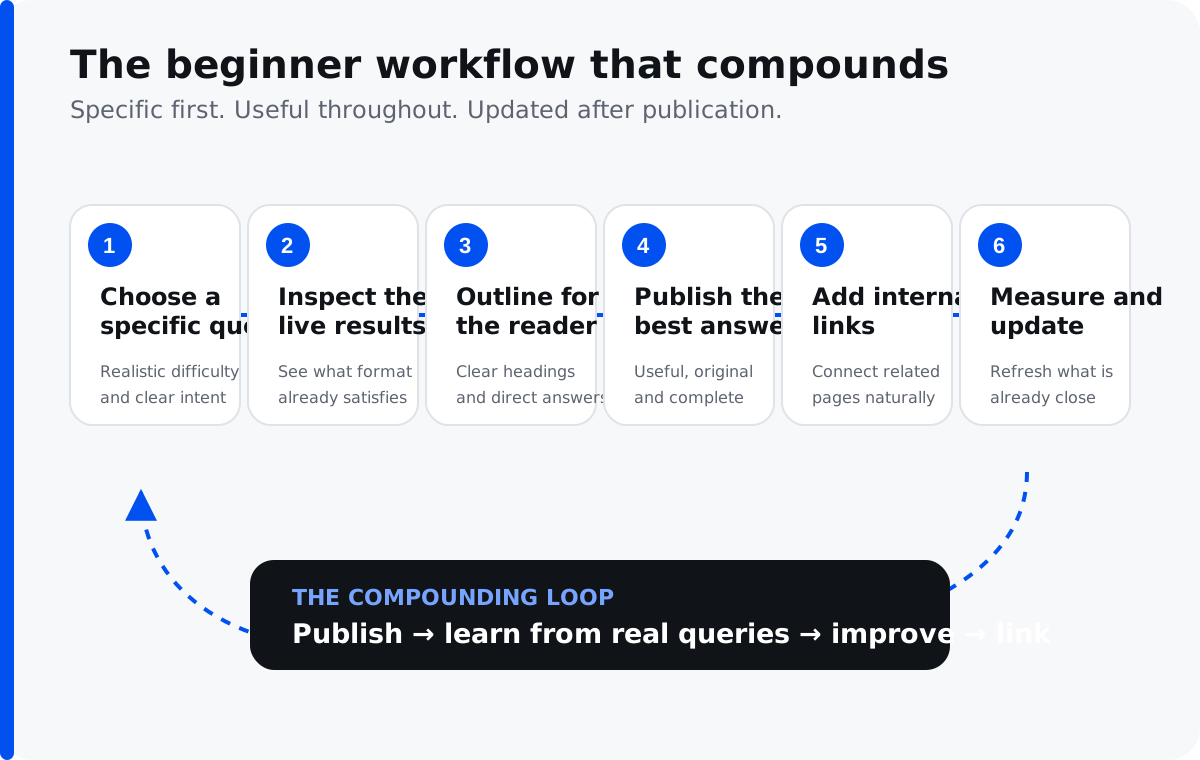
Search your intended topic and look at what occupies the first page. If it is entirely major brands and established publications, reconsider. If there are smaller sites, forum threads or genuinely mediocre content, there is an opening.
Also check what type of content ranks. If every result is a comparison list and you were planning an essay, you have misread the intent — and no amount of quality will fix a format mismatch.
Structure posts so they can be followed
Good structure serves readers first and search engines as a consequence.
Answer early. If your title poses a question, answer it in the first paragraph, then expand. Making readers scroll past three hundred words of preamble is how you lose them, and it is exactly the pattern search engines notice.
Use one H1 and a sensible heading hierarchy. Your title is the H1; sections are H2s; subsections are H3s. Do not skip levels for visual effect.
Write headings that describe content. "How much it costs" is more useful than "Costs", and considerably more useful than something clever. Headings are how people scan and how machines interpret structure.
Keep paragraphs short. Dense blocks of text get abandoned, particularly on phones where most reading happens.
The basics that still matter
Write a title tag that describes the page and includes what people search for, kept short enough not to truncate. Write a meta description that gives someone a reason to click — it is not a ranking factor, but it affects whether the ranking produces a visit.
Use a short, descriptive URL. A post about local SEO should sit at something like /blog/local-seo-guide/ rather than a string of words and a date. Short URLs are easier to share, easier to read in results, and cleaner to maintain.
Compress your images and give them descriptive filenames and alt text. Images are the most common cause of slow blog pages, and a slow page loses readers before they read anything.
Internal linking is the most underused tactic
Every time you publish, link to two or three relevant existing posts, and go back to older posts to link forward to the new one. This does three things: it helps readers find more of your work, it distributes authority across your site, and it helps search engines understand which of your pages relate to each other.
Use descriptive link text. "Our guide to improving local rankings" tells both readers and search engines what to expect; "click here" tells them nothing.
Blogs that do this well accumulate a genuine advantage over time, because each new post strengthens the ones before it. Blogs that publish in isolation end up with dozens of orphaned pages that nobody, including search engines, ever reaches.
Write for the reader, genuinely
The advice sounds trite and it is measurable. Search engines increasingly assess whether people got what they came for — whether they stayed, read, and stopped searching. Content written to hit a keyword count fails that test, because it reads like content written to hit a keyword count.
Keyword density has not been meaningful for many years. Modern search engines understand synonyms and context perfectly well. Cover the topic thoroughly in natural language and the terminology takes care of itself.
What does help is including things only you can offer — your own examples, your own data, your genuine opinion, the mistake you made and what it taught you. Anything assembled from what is already published will read like what is already published, and there is no reason to rank it above the original.
Keyword research for blog posts
Every winnable blog post starts with keyword research, because the keyword you target decides whether the post has any chance before you write a word. The goal is to find a keyword with real search volume, intent that matches what you can offer, and low enough keyword difficulty that a site your size can rank. Long-tail keywords — longer, more specific search queries — are where bloggers win, because they carry less competition and clearer intent than the broad head terms major publications own.
A simple process: start with a seed topic, use a keyword research tool to expand it into dozens of related queries with their search volume and difficulty, then filter to the long-tail terms you can realistically rank for. Check the search results for each shortlisted keyword to confirm the intent and the format Google rewards. Map one primary keyword to each blog post rather than stuffing several in — modern search engines understand synonyms, so covering the topic thoroughly in natural language matters far more than repeating the exact phrase.
SEO plugins and tools for bloggers
If you blog on WordPress, an SEO plugin removes most of the on-page busywork. Yoast SEO and Rank Math both manage your title tag, meta description, canonical tags, XML sitemap and schema, and prompt you when a post is missing the basics. They will not write good content or do your keyword research, but they stop you shipping a blog post with a truncated title or a missing meta description.
Beyond the plugin, a handful of tools cover the rest: a keyword research tool for topic selection and search volume, Google Search Console to see which queries already bring you organic traffic and which posts are close to breaking through, and Google Analytics to see what readers do once they arrive. The plugin handles the mechanics of on-page SEO; the research tools tell you what to write about next. Together they turn consistent publishing into compounding organic traffic rather than a pile of orphaned posts.
Be realistic about timescales
New blogs take time. Expect several months before anything meaningful happens, and longer on a new domain with no existing authority. Most people who give up on blogging do so at around month four, which is typically just before results begin appearing.
Publishing consistently matters more than publishing frequently. One genuinely useful post a fortnight, sustained for a year, produces far more than daily posts for six weeks followed by silence.
Update what you already published
Frequently higher return than writing something new, and almost universally neglected. A post ranking on page two often needs improvement rather than replacement — more depth, better structure, updated information, stronger internal links. It already has some history and authority, which a new page does not.
Review your existing posts periodically and ask which are close to breaking through. Improving those is usually the fastest available gain.
Measure what your blog is actually doing
Once posts are live, Google Search Console is the one tool a blogger should check regularly. It shows the exact search queries bringing you organic traffic, which posts earn impressions but few clicks (usually a title or meta description problem), and which are ranking on page two where a small improvement could break them through. Pair it with a simple analytics view of which posts hold attention, and you have a feedback loop: write, measure which keywords land, then improve the posts that are close. That loop — not raw publishing volume — is what turns a blog into a compounding source of organic traffic.
Where to go next
Pick one specific topic you can genuinely write better than what currently ranks. Answer it directly, structure it clearly, and link it to your related posts. Then do it again in a fortnight.
If you want the process handled properly — research, briefing, production and internal linking — our SEO content writing service covers it, and SEO services handles the technical and authority work underneath. Our technical SEO checklist covers the foundations worth getting right early.
Google's guidance on creating helpful content is the most useful single document for anyone starting out.