Off-Page SEO: How to Build Authority That Actually Ranks

Off-page SEO is everything that builds your site's authority from outside it — links from other websites, brand mentions, reviews and general reputation. It is the hardest part of SEO to influence and usually the reason an established competitor outranks a site with better content.
What off-page SEO actually covers
Most people equate off-page SEO with link building, which is understandable but incomplete. Links remain the strongest single signal, but the broader category includes unlinked brand mentions, reviews and ratings, presence in industry directories and publications, and the general question of whether your brand appears credible when someone checks.
That wider framing matters more now than it did, because AI answer engines weigh corroboration heavily. Being mentioned across multiple credible sources makes a brand a safer thing to cite — which we cover in more depth under AI SEO.
Why links still matter
Search engines need some way of judging whether to trust one site over another when both cover a topic competently. Links from established sites remain the most reliable available proxy, because they are relatively difficult to fake at scale.
What has changed is the emphasis. Volume mattered enormously fifteen years ago; relevance and quality matter far more now. A single link from a respected publication in your field is worth more than hundreds from unrelated directories — and the hundreds carry risk that the one does not.
Approaches that still work
Publish something worth linking to
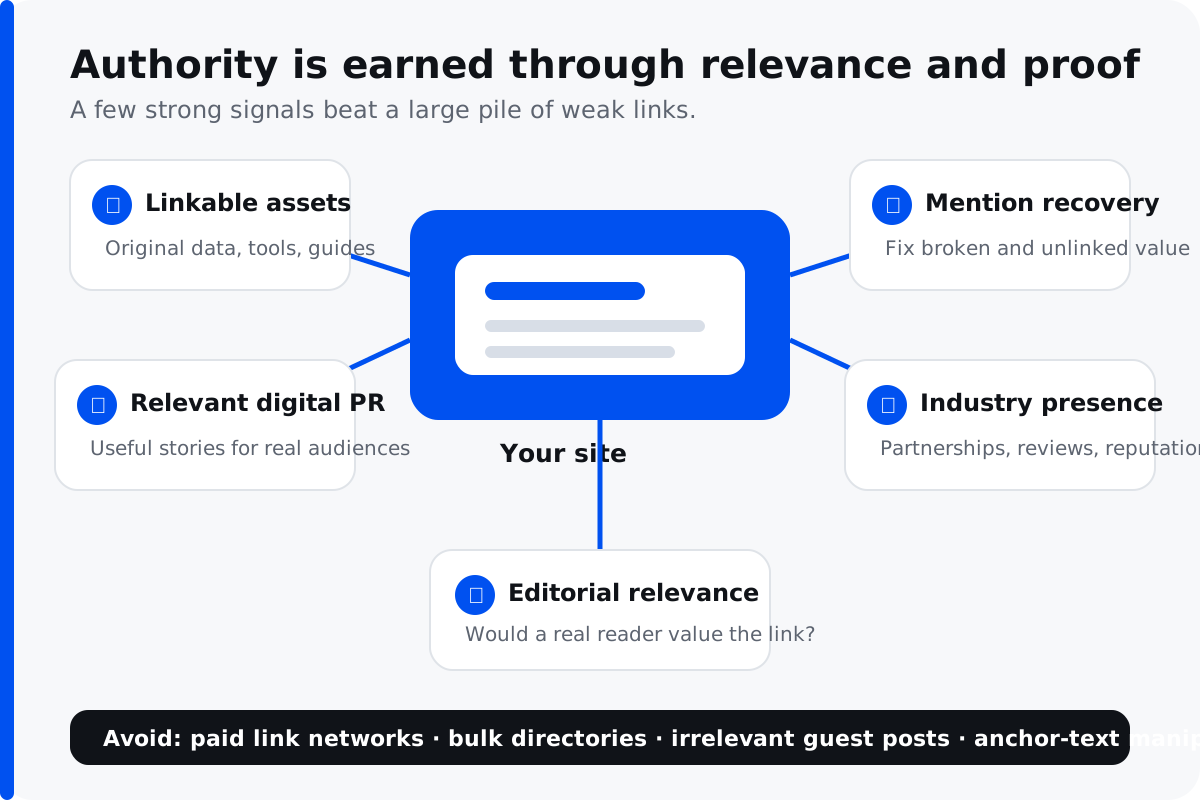
Unglamorous but genuinely effective. Original research, proprietary data, genuinely useful free tools, and comprehensive guides that go further than anything currently available all attract links without asking. This is slow, and it requires having something to say that others do not.
Digital PR
Getting your business or your expertise into publications your customers actually read. Commenting on industry developments, offering genuine expert perspective to journalists, publishing data others want to reference. This produces the highest-quality links available and it also produces business directly, which is a reasonable justification on its own.
Fix what you already have
Frequently the fastest available gain. Find pages linking to URLs on your site that no longer exist and redirect them properly. Find unlinked mentions of your brand and ask politely for a link. Neither requires new relationships and both recover authority you already earned.
Be genuinely present in your industry
Trade associations, supplier and partner pages, local business organisations, sponsorships, speaking. These produce relevant links, and unlike most tactics they are difficult for a competitor to replicate quickly because they reflect actual involvement.
Approaches to avoid
Buying links violates search engine guidelines and carries real risk of a penalty. Private blog networks are detectable and the sites hosting them get deindexed regularly. Automated outreach at scale produces mostly worthless links from sites that link to anyone. Guest posting purely for links on sites that exist to publish guest posts is transparent and increasingly ineffective.
The consistent tell is whether the link would exist if search engines did not. If not, it is a risk you are taking rather than an asset you are building.
Reviews and reputation are off-page too
Review profiles influence local rankings directly and influence conversion everywhere. Ratings on Google, industry platforms and marketplaces all contribute to how credible your brand appears, and they are read by AI systems assembling answers about you.
If you serve a geographic area, this overlaps heavily with local search — our guide to improving local rankings covers the review side in practical detail.
On-page SEO vs off-page SEO
It helps to place off-page SEO next to its counterpart. On-page SEO focuses on optimising the things you control directly — content, headings, internal links, page speed, structured data. Off-page SEO covers everything that happens outside your website: backlinks, brand mentions, reviews and social signals that tell search engines other people find you credible. On-page SEO ensures a page deserves to rank; off-page SEO is what convinces search engines to trust it over an equally good competitor. You need both, and off-page work is wasted if the on-page and technical foundations are weak.
Off-page SEO beyond backlinks
Because off-page SEO is so often reduced to link building, the other signals get neglected — and several of them are easier to influence.
Brand mentions and brand searches
Search engines increasingly treat unlinked brand mentions as a signal in their own right, and a rising volume of brand searches — people typing your name directly — tells them a brand is real and in demand. Digital PR, content marketing and being genuinely present in your industry all drive both.
Social media platforms
Links from social media platforms are typically nofollow and do not pass authority directly, but they distribute content to the people who do link, and they build the brand searches above. Treat social as amplification for your linkable assets rather than a link source.
Google Business Profile and reviews
For any business serving a location, a complete Google Business Profile and a steady flow of reviews are among the most powerful off-page SEO signals available. They feed local rankings directly and shape how credible your brand looks to both people and AI systems assembling an answer about you.
Influencer marketing and guest posts
Done for genuine reach rather than a raw link, influencer marketing and the occasional well-placed guest post on a relevant, respected publication still earn quality backlinks and put your brand in front of the right audience. The test is the same as always: would the placement be worth doing if search engines did not exist?
How to find opportunities that actually exist
The practical starting point is a competitor gap analysis. Take the three or four sites consistently outranking you, look at where their links come from, and separate that list into two groups: sites that link to multiple competitors but not you, and sites unique to one competitor.
The first group is the higher-priority list. If a publication, directory or association has linked to three businesses in your category, it is demonstrably willing to link to a fourth — the barrier is that they do not know you exist. Those are conversations worth having.
The second group tells you something different: usually a relationship, a client, a supplier or a piece of coverage specific to that business. Less directly actionable, but it shows you what kinds of opportunity exist in your industry.
Beyond competitors, the sources most businesses overlook are the relationships they already have. Suppliers with partner pages. Clients who could be asked for a case study mention. Trade bodies you pay membership to and are listed on incorrectly, or not at all. Events you sponsored where the link never got added. This is unglamorous administrative work and it usually produces more than any outreach campaign.
Measuring progress honestly
Link building is unusually easy to fool yourself about, because activity is visible and results are slow. A month of outreach feels productive whether or not it produced anything worth having.
The metrics worth tracking are the number of genuinely relevant referring domains gained, whether rankings for target terms are moving, and whether referral traffic from those links is real. That last one is a useful sanity check — a link that never sends a single visitor is not necessarily worthless, but a pattern of them suggests you are acquiring links nobody sees.
Be sceptical of third-party authority scores as a progress measure. They are estimates produced by tools with their own crawl data, not signals search engines use, and it is entirely possible to raise a score while acquiring links that do nothing for you. Rankings and revenue are slower to move and considerably more honest.
How to judge whether a link is worth pursuing
Three questions. Is the site genuinely relevant to your field? Would a real person plausibly click that link? Would you want the link if search engines did not exist? A yes to all three means it is worth effort. A no to any of them usually means it is not.
Ignore domain authority scores as a primary filter. They are third-party estimates, not signals search engines use, and optimising toward them leads to chasing numbers rather than relevance.
How long authority takes to build
Longer than anything else in SEO. Technical fixes can show results within weeks and content within months, but authority accumulates over years, which is precisely why it is defensible once you have it. A new domain competing against a competitor with fifteen years of accumulated links is facing a gap that cannot be closed quickly at any budget.
This is also why we sometimes advise against SEO as a primary channel. If your category is dominated by long-established sites and you need results this quarter, paid ads is the honest recommendation while authority builds in the background.
Where this fits
Off-page work only pays off when the foundations underneath it are sound. Links pointing at a slow, poorly structured site are wasted, so sequence matters: fix the technical layer, build content worth linking to, then earn the authority. Our SEO services run all three together, in that order.
Google's guidance on link spam policies is worth reading before pursuing any tactic you are unsure about.