International SEO: How to Rank in Multiple Countries

International SEO is the work of making search engines show the right version of your site to people in different countries or languages. It comes down to three decisions: what URL structure to use, how to signal which version suits which audience, and whether you are genuinely targeting a country or simply a language. Get those wrong and translation work is wasted.
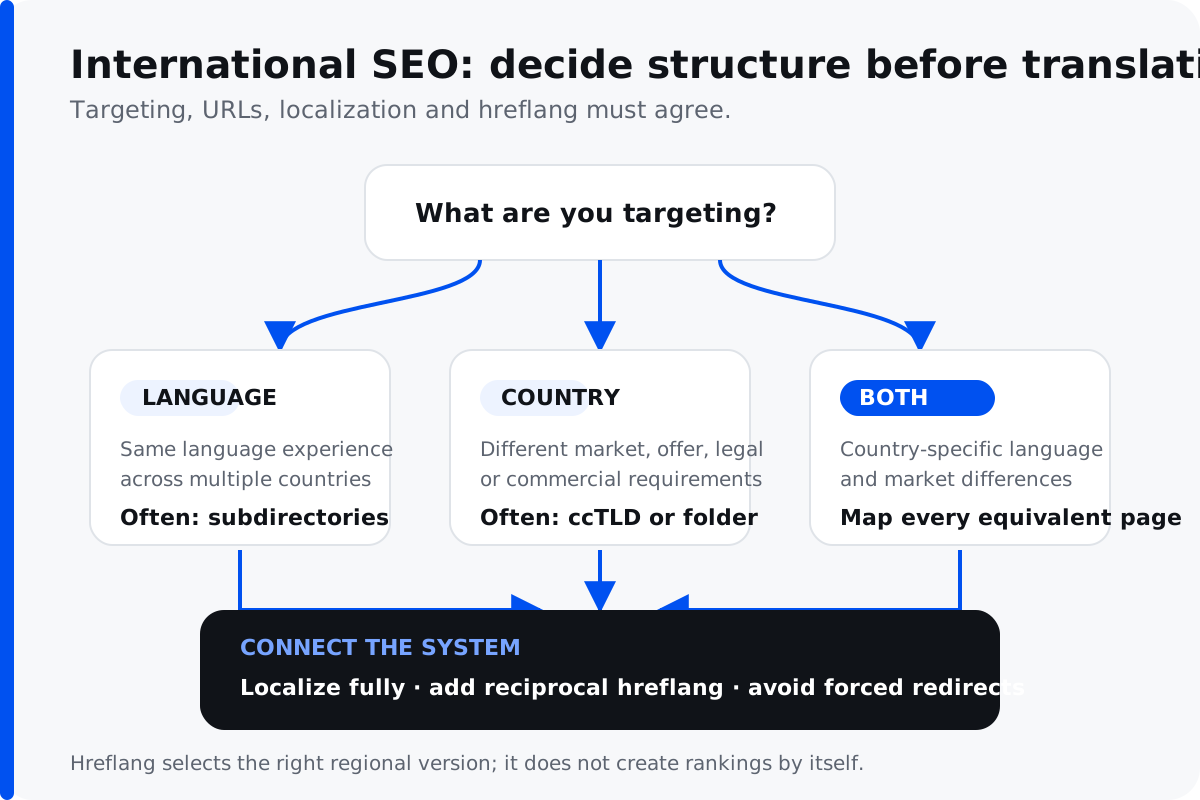
Language targeting and country targeting are different problems
This distinction causes more confusion than anything else in international SEO, so it is worth settling first.
Language targeting means serving Spanish speakers wherever they are. One Spanish version, aimed at anyone who reads Spanish. Appropriate when your offer does not change by country — software, digital products, information.
Country targeting means serving Spain differently from Mexico, even though both speak Spanish. Different pricing, currency, shipping, legal terms, sometimes different products entirely. Appropriate when the commercial reality genuinely differs.
Businesses frequently build country targeting when they only needed language targeting, which multiplies the number of pages to maintain for no benefit. Ask whether anything other than the words actually changes. If not, one language version will serve you better than eight near-identical country versions competing with each other.
Choosing a URL structure
Three options, each with real trade-offs. There is no universally correct answer, which is why this decision deserves proper thought before anything is built.
Country-code domains
Separate domains per country. The strongest possible geographic signal and often the best user trust locally, because a local domain looks native. The cost is that each domain builds authority independently — you are effectively running several websites, and a new one starts from nothing regardless of how established the others are.
Worth it when a market is genuinely significant and you can invest in it properly. Rarely worth it for speculative expansion into a market you are testing.
Subdirectories
Folders on one domain, like /de/ or /fr/. All versions share the domain's accumulated authority, which is a substantial advantage — a new market launch inherits the trust you already built. Simpler to manage, cheaper to maintain, and the most common recommendation for businesses that are not enormous.
The weaker geographic signal matters less than it used to, because hreflang does most of that work now.
Subdomains
Separate subdomains, like de.example.com. Sits between the other two — some separation, some shared authority, though how much authority actually passes is debated. Occasionally chosen for technical reasons when different markets run on different infrastructure.
Unless you have a specific reason, subdirectories are usually the pragmatic default.
Hreflang: what it does and how it goes wrong
Hreflang tags tell search engines that several pages are alternate versions of each other for different audiences, so the right one gets shown. It does not affect rankings directly — it affects which version ranks, which matters enormously for conversion.
The implementation rules are simple and constantly broken:
Tags must be reciprocal. If your English page points to the German version, the German page must point back. One-directional tags are ignored entirely, and this is the single most common implementation error.
Every version must include a tag pointing to itself. Omitting the self-reference invalidates the set.
Use the correct codes. Language codes follow one standard, country codes another. A frequent error is using "en-UK" — the correct code for the United Kingdom is "GB". Invalid codes are simply discarded.
Point to canonical URLs. Hreflang tags pointing at pages that redirect, or at non-canonical versions, will not work reliably.
Add an x-default tag indicating which version should serve users whose language or region you have not specifically targeted. Without it, search engines guess.
Do not auto-redirect based on location
Automatically redirecting visitors to a version based on their IP address feels helpful and causes real problems. Search engine crawlers usually crawl from one country, so if you redirect them by location they may only ever see one version of your site — the others never get indexed at all.
It also frustrates legitimate users: someone travelling, an expatriate who wants their home version, a customer researching a market they are moving to. The better pattern is a visible suggestion — a banner offering the local version with a clear way to dismiss it — while leaving the requested URL accessible.
Translation is not localisation
Machine-translated content ranks poorly and reads worse. Beyond quality, translation misses everything that actually matters commercially: how people in that market search, what terminology they use, what objections they have, what proof convinces them.
Keyword research has to be redone per market rather than translated. The literal translation of your best-performing English keyword is frequently not what people in that country type. Currency, units of measurement, address formats, payment methods and legal requirements all need genuine localisation too — and a checkout that only offers payment methods nobody in that market uses will convert terribly regardless of how well the page ranks.
International keyword research
International keyword research is the part most teams underestimate, and it is where a global SEO strategy is won or lost. You cannot translate a keyword list — search behaviour differs by market. The literal translation of your best-performing English term is frequently not what your target audience actually types, and in some markets a different search engine (Baidu in China, Yandex in Russia, Naver in South Korea) shapes demand entirely.
Redo keyword research per country and language using local-language tools and, where possible, native speakers. Look at search volume and keyword difficulty in that specific market rather than assuming they mirror your home one. This is what separates genuine international SEO from translated content: you are optimising for how a local audience searches, not how you assume they do.
Tools and measuring international SEO performance
A few tools make international SEO manageable. Google Search Console lets you set geographic targeting for subdirectories and reports performance by country, so you can see which international pages are ranking where. Google Analytics segments traffic and conversions by market, which is how you judge whether a market is worth deepening. Platform tools like Semrush or Ahrefs track international keyword rankings across locations. For hreflang specifically, a validator saves hours of debugging reciprocal-tag errors.
Measure international SEO performance market by market, not in aggregate. A global number hides the truth — one strong market can mask several that are failing. Track keyword rankings, organic traffic and conversions per country, and treat each market as its own small SEO project with its own target market, its own competitors and its own definition of success. That is how successful international SEO scales: prove the model in one market, then repeat it deliberately rather than launching everywhere at once.
Common reasons international SEO fails
The recurring pattern is expanding too broadly, too fast. Launching eight markets simultaneously means eight sets of content nobody has time to maintain, eight keyword strategies nobody researched properly, and thin translated pages competing for attention. One market done thoroughly beats eight done superficially, and it gives you a template that works before you scale it.
The second common failure is treating international as a technical project. Hreflang and URL structure are necessary but they are not sufficient — a correctly implemented site with poorly localised content will not compete against local businesses who understand their own market.
Benefits of getting international SEO right
Done properly, international SEO compounds. Each market you localise adds qualified organic traffic you are not paying for per click, and because most competitors expand carelessly — thin translations, broken hreflang, one bloated site trying to serve everyone — a business that localises one market thoroughly often outranks larger rivals who spread themselves thin. The benefits are practical: the right language and currency shown to the right audience lifts conversion as much as ranking, fewer support problems arise from customers landing on the wrong regional version, and a clean multilingual SEO foundation makes the next market cheaper to launch than the last. Treat international SEO as a repeatable playbook rather than a one-off translation project and it becomes one of the more durable growth channels available. The compounding effect is the real prize: the research, tooling and hreflang discipline you build for the first market carry straight into every market after it.
Where to start
Look at your analytics before deciding anything. If you already receive meaningful traffic or enquiries from a country, that is evidence of demand and the obvious place to begin. Expanding into markets on the basis of ambition rather than evidence is how businesses end up maintaining pages nobody visits.
Then confirm the commercial basics: can you actually deliver there, take payment, and support customers in that language? International SEO succeeds fastest where the operational side is already solved.
The technical implementation sits within our technical SEO work, and the wider strategy under SEO services. If you are selling physical products across borders, the catalogue considerations in our eCommerce SEO guide apply on top.
Google's documentation on localized versions of your pages covers hreflang implementation in detail and is worth following exactly.